Airport Security Checkpoint 2026: How the Screening Process Actually Works
Metal detector or body scanner, shoes off or left on, laptop out or left in the bag — at the checkpoint, guesswork beats knowledge far too often. How screening at German airports actually works in 2026, step by step.

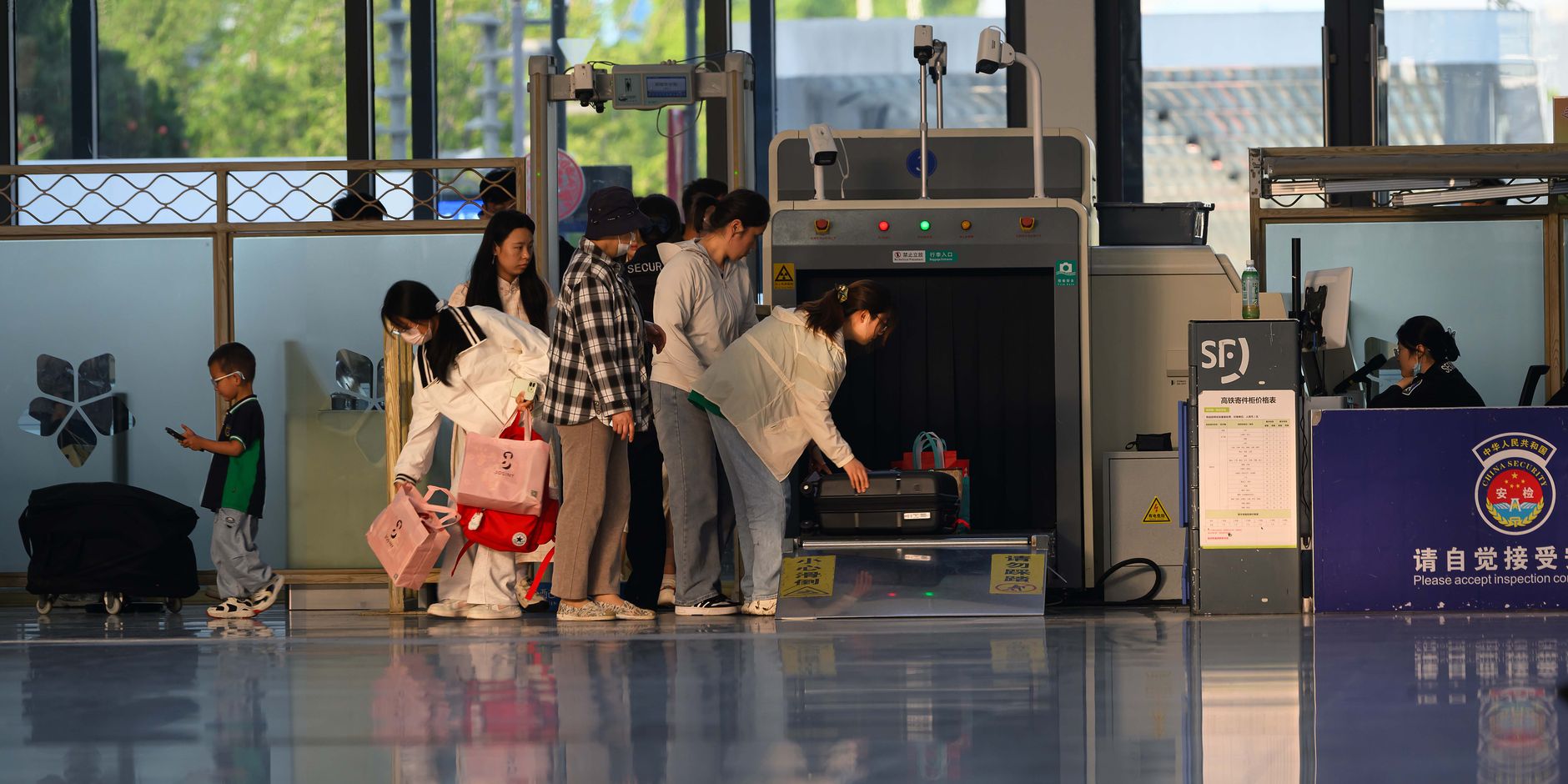
The security checkpoint is where the most stubborn travel myths collide. Some passengers take their shoes off out of habit, because that’s what happens in the US. Others still put the laptop in the tray on its own, because that was compulsory everywhere just a few years back. Both habits are out of date on plenty of German lanes now — and were never quite true on others. What actually applies depends on which equipment is running on your particular lane, what you’re wearing, and whether you know what comes next before it’s your turn. The rules on liquids, battery devices and case dimensions are covered elsewhere in detail; this is about what happens to you and your bag at the checkpoint itself.
Who screens you, and under what legal authority
Responsibility for security screening at German airports sits with the federal police, the Bundespolizei, under section 5 of the Aviation Security Act (Luftsicherheitsgesetz). In practice, though, it’s rarely a federal police officer standing at the belt: the authority can delegate the task to contracted private security firms operating on its behalf and under its supervision. So if the uniform at the arch doesn’t look like the police, that’s not an oversight — it’s the norm. Federal police officers are present at nearly every major checkpoint, but tend to step in personally only for flagged items, alarms or refusals.
Screening follows EU-wide rules applied in Germany through the Aviation Security Act and its implementing regulations. In practice that means the process barely differs between German airports — differences come almost entirely from the equipment installed on a given lane, not from different rules.
The checkpoint process, step by step
Before you even reach the actual screening lane, there’s usually a separate boarding pass and ID check — automated through a scanner gate at some airports, done by staff at a desk at others. Only after that does the real screening begin, and it runs as two parallel tracks: your bag through the X-ray, you through the scanner.
If you live outside the EU and want the German VAT back on what you bought here, there’s one more stop before all of this: the customs stamp on your export certificate has to happen before the case goes on the belt — the process is covered under VAT refund at the airport.
For your bag that means: take a tray, put your jacket and belt in it (more on that shortly), and on conventional lanes add your laptop and liquids bag separately on top, then onto the belt. On CT lanes — covered below — much of that can simply stay inside your case or rucksack.
At the same time, you walk through either the metal detector arch or the body scanner, whichever your lane has. Nothing flags, and you’re through in seconds. At the far end you wait for your bag — and that’s exactly where the biggest perceived delay happens, when your bag gets held back and checked individually for some reason while you yourself cleared ages ago.
One detail that catches people out: your bag and your body aren’t treated as a single unit. It’s entirely routine to walk through without a single alarm while your rucksack sits in the X-ray image for another two minutes, because a tangle of cables or a densely packed bag has made the image hard to read.
Metal detector or body scanner: what happens at the arch
Which technology you get isn’t down to choice. Smaller airports, and some lanes even at large ones, still run the classic walk-through metal detector (WTMD): you walk through, and it either alarms or it doesn’t, without pinpointing where on your body the metal actually is. If it alarms, a targeted follow-up with a handheld wand or a manual check follows, usually around the belt, pockets or shoes.
At the larger German airports — Frankfurt, Munich, Stuttgart and Berlin among them — many lanes now run millimetre-wave body scanners instead. The routine: stand on the marked footprints, raise your arms out to the sides, and the scanner reads your body with radar waves for a few seconds. Unlike the older machines some travellers remember, the screen shows no anatomical image at all — just a neutral, gender-neutral outline. If nothing stands out, the screen simply shows OK. If something does — a belt, a heavy zip, a phone left in a trouser pocket — the outline marks the exact zone, and only that zone gets checked by hand. Everything else is left alone.
One thing many people don’t realise: the body scanner is voluntary in Germany. You can decline it and ask for a manual check instead — in practice, most travellers still choose the scanner anyway, because it’s faster and less intrusive than being patted down.
The CT scanner for hand luggage: where laptops and liquids can stay put
The second major technology shift affects your bag rather than you. Conventional X-ray produces a flat, two-dimensional image in which liquids and densely packed electronics are hard to read cleanly — which is why laptops and liquids bags still go into the tray separately there. CT scanners (computed tomography, the same technology used in medical imaging) instead build a rotatable 3D image that staff can examine layer by layer without anything being unpacked.
On CT lanes, the rule is: laptops, tablets and liquids up to two litres can stay in your bag, and the clear plastic bag is no longer required. Equipped, as of 2026, are among others selected lanes in Frankfurt, mainly in Terminal 3, plus in Munich the checkpoints in Terminal 1 Module D, the Terminal 1 pier, and the central checkpoint in Terminal 2. BER is mid-rollout too: security areas 1 and 5 in Terminal 1, plus the checkpoint in Terminal 2, run CT technology, while areas 2 and 4 in Terminal 1 are still conventional.
Two caveats still matter. First, you don’t get to pick your lane — which one you’re sent to depends on the terminal, how busy it is, and staff allocation, not your preference. Second, every other lane — still the majority nationwide — runs the old rule unchanged: electronics into the tray individually, liquids in the one-litre bag, 100 ml per container. The full detail on that, including the trap of connecting between a CT airport and a conventional one, is under liquids in hand luggage. What applies to battery devices such as shavers and power banks, regardless of which scanner your lane has, is under electric toothbrush on a plane.
Shoes, belt, jacket: what actually has to come off
The most persistent mix-up at German checkpoints comes straight from American television: no, you don’t have to take your shoes off as standard. At German airports shoes generally stay on — they only come off if they have unusually thick soles, a metal shank (common in some boots), if the metal detector alarms on you, or if staff pick you for a random check. If you’re asked to remove them, they go through the X-ray in a tray, not into a staff member’s hands.
The belt is a recommendation rather than a strict requirement: a narrow belt with a small buckle rarely triggers anything. A wide leather belt with a large metal buckle almost always does — and that’s exactly what costs you the extra lap around the arch. Anyone wearing an obviously metal belt saves time by putting it straight in the tray rather than finding out the hard way.
Jackets, coats, thick scarves and hats, on the other hand, always come off and go through the X-ray separately — regardless of whether your lane has CT technology or not. That distinction only affects electronics and liquids in your bag, not what you’re wearing. Trouser pockets should be empty before you reach the tray too: keys, coins, wallet, boarding pass and a bulky watch belong in the tray or in your bag’s outer pocket, not in a pocket where the scanner is the first place they get noticed. Sort that out in the queue rather than at the arch, and you’re regularly through while the person behind you is still working on their belt.
What triggers a manual follow-up check
A follow-up check isn’t an accusation — it’s simply the normal second step whenever the equipment can’t resolve something on its own. The most common triggers:
The metal detector alarms. Because the classic arch doesn’t localise where the metal is, a check with a handheld scanner or a targeted pat-down follows, usually around the belt, shoes or pockets, rarely the whole body.
The body scanner marks a zone. Unlike the arch, staff already know exactly where to check — a belt, a trouser pocket, a fold of fabric under heavy clothing. Only that one area gets checked, not your entire body.
You decline the scanner. That’s entirely your right, but it automatically means a full manual check as the alternative, usually alongside an explosive trace test — a swab wiped over your hands or your bag and then read by a machine. That’s routine, not suspicion.
Something in your bag can’t be identified clearly on the X-ray. Staff open the bag, usually with you present, and check the item by hand — a tangle of cables, a packed toiletry bag or a laptop charger with a bulky plug trip this more often than most things.
Random spot checks. Independent of any alarm, a share of passengers are pulled aside at random, with no visible trigger at all.
One special case worth knowing about on certain routes: for specific destinations, such as flights to Israel or the United States, a second, separate security check takes place at the gate — at BER, for instance, within a window that opens two hours before departure and closes thirty minutes before it (as of 2026). It doesn’t apply to every flight or every airport, but if you’re booked on a route like that, build in extra time at the gate itself, not just at the main checkpoint.
How long you’ll really be queuing
There’s no single reliable figure, because too many factors act at once: airport size, terminal, day of the week, time of day and season move queue times far more than any single baggage rule does.
As a rough rule of thumb that holds at practically every German airport: allow two hours before departure for Schengen and domestic flights, three hours for flights outside the Schengen area. That’s a general recommendation, not a precise forecast for your particular flight — a quiet Tuesday morning often needs far less, while the first Friday of the school holidays can make even that tight.
Almost everywhere gets busiest between five and eight in the morning, when short-haul and charter departures bunch together, and on the first day of school holidays. At major hubs like Frankfurt, queue times run around fifteen to thirty minutes under normal conditions, rising to forty-five minutes or more on holiday-start mornings. At smaller regional airports — Dortmund, Hahn, Nuremberg — waits stay well below that even at busy times, often in single-digit minutes, simply because far fewer passengers are working through the same number of lanes.
One practical tip: Frankfurt and Munich publish rough, regularly updated current queue-time estimates on their websites and apps. Checking beforehand doesn’t replace a sensible buffer, but it does help decide whether to leave five minutes earlier or not. And if the queue is long because of industrial action: missing an on-time flight for that reason falls expressly outside the EU passenger rights regulation — why that is, and what you are owed when a strike does hit the flight itself, is covered under Strikes, delays and cancellations.
How to get through faster
Some of the wait is down to chance — the start of the holidays, the day of the week, the terminal. The rest is down to you, and that part you can influence.
Start sorting yourself out in the queue, not at the tray. Jacket off, belt off, pockets emptied — do that before it’s your turn and the belt takes seconds rather than half a minute with a queue building behind you.
Watch the signage. Airports with mixed lanes often mark which ones run CT technology. If you have a choice, the CT lane is almost always faster because less has to come out of your bag. If you don’t have a choice, don’t waste time hunting for one — take the next free lane.
Dress a little more conservatively on travel days. If you know you tend toward the wide belt with the oversized buckle or the boots with a metal shank, save them for another day — not because they’re against any rule, but because they almost always mean an extra lap.
If you’re picked out, cooperate quickly rather than arguing. A targeted follow-up on one marked zone usually takes under two minutes. Complain or negotiate and you only extend exactly what you were trying to speed up.
Keep your boarding pass and ID within reach, not just for the checkpoint itself but for a possible second check at the gate on certain routes. And while you’re preparing your hand luggage anyway: a case that’s the right size to begin with closes again in the tray far faster than one stuffed to the limit — current dimensions for the major airlines are under hand luggage sizes 2026.
Security will never be the most relaxing part of your trip, but it doesn’t have to stay a guessing game either. The equipment decides the details — bag or no bag, laptop out or left in — while the basics stay the same on practically every German lane: jacket off, pockets empty, cooperate if you’re asked a follow-up question. Know those basics and bring a realistic time buffer, and the CT lane becomes a pleasant surprise rather than the conventional one becoming an irritation — because either way, you planned for it from the start.
Keep reading

Departure & Security
Food in Hand Luggage: What Gets Through Security — and What You Cannot Bring Home
Food in hand luggage 2026: why yoghurt, soft cheese and honey count as liquids at security, how the baby-food exemption actually works, and which foods the EU bans on the way back in.
Sophie Bauer17 September 2026
Departure & Security
Liquids in Hand Luggage 2026: The 100 ml Rule Still Applies — Mostly
Liquids in hand luggage 2026: the 100 ml rule still applies, with two litres on CT lanes at Frankfurt and Munich. Exemptions, duty-free and the transfer trap.
Sophie Bauer14 August 2026
Departure & Security
Electric Toothbrush on a Plane 2026: The Battery Rules for Hand Luggage
Electric toothbrushes, power banks and e-cigarettes in hand luggage: watt-hour limits, loose versus built-in batteries and what happens at security (as of 2026).
Sophie Bauer2 August 2026
Departure & Security
Hand Luggage Sizes 2026: What Each Airline Actually Allows
Hand luggage sizes 2026 compared: Lufthansa, Ryanair, Eurowings, easyJet, Wizz and Condor — plus the one case size that clears all six airlines.
Sophie Bauer12 August 2026
Departure & Security
Wizz Air Hand Luggage 2026: 40 × 30 × 20 Free, a Trolley Only With WIZZ Priority
Wizz Air hand luggage in 2026: a free 40 × 30 × 20 cm bag up to 10 kg, a 55 × 40 × 23 cm trolley only with WIZZ Priority, what Priority costs online and at the airport, and what awaits at the gate (as of September 2026).
Sophie Bauer25 September 2026