Excess Baggage Fees 2026: What an Overweight Case Really Costs
Three kilos over, and the check-in desk quotes a number nobody budgeted for. How airlines actually price checked and excess baggage in 2026, why booking online is almost always half the price — and how to work out before you book whether to pay, repack or post it.

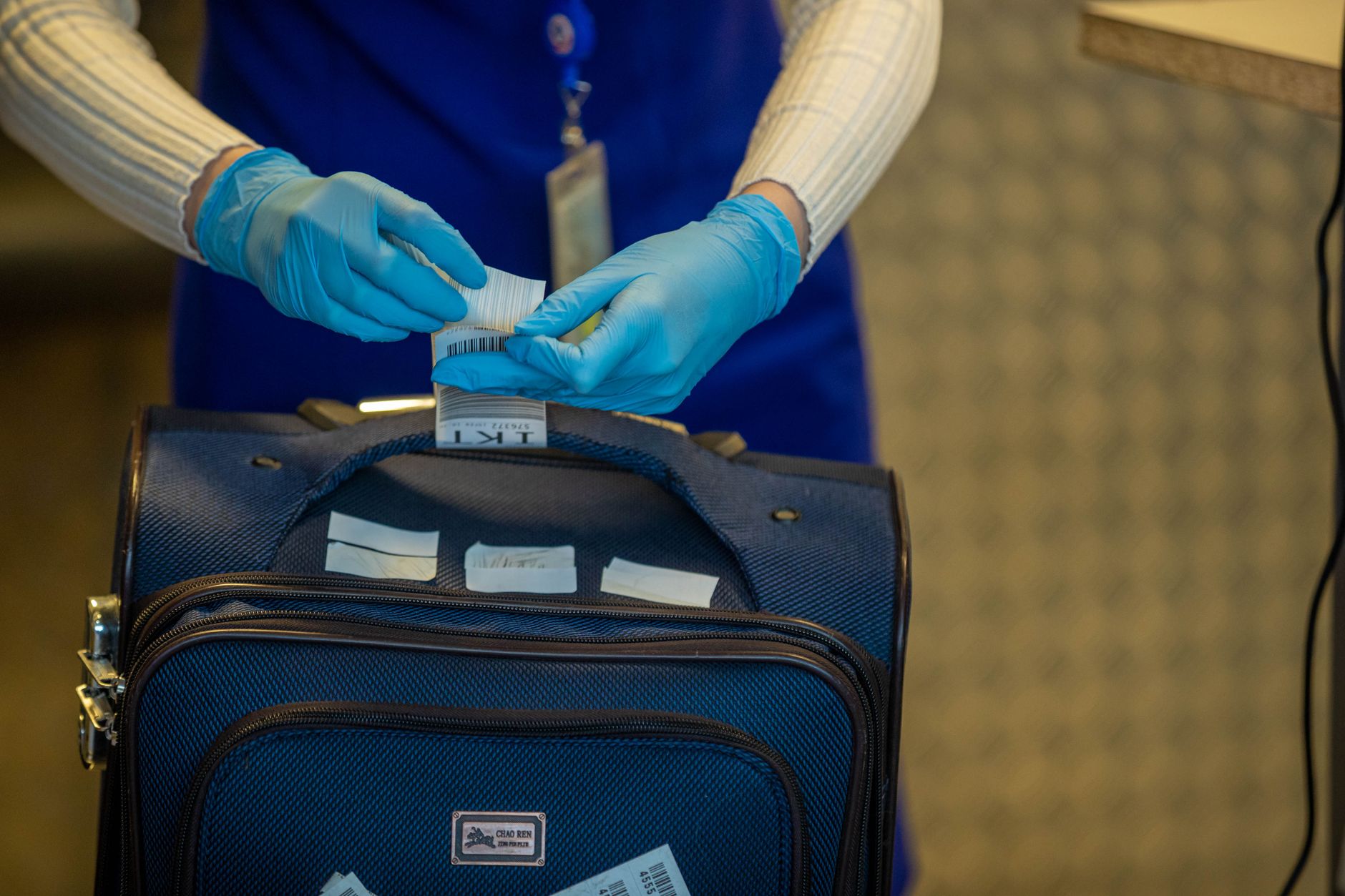
The most expensive moment of a flight lasts about four seconds. The case sits on the scale, the display settles, and the agent turns the screen towards you: 26.4 kilos. The allowance was 23. What follows isn’t a negotiation, it’s a price — and specifically the highest price that airline charges for this one bag anywhere in its system.
The real substance of the topic has very little to do with kilos: at almost every airline, checked baggage is a product with a moving price, and that price climbs the later you buy it. Know this and the worst you lose at the belt is time. Miss it and you routinely pay more for the suitcase than for the seat.
Why the same case has three different prices
Airlines treat baggage exactly like seat selection or priority boarding: an add-on with a tiered price. Cheapest inside the booking flow itself, dearer when added later through “manage my booking”, dearest of all at the check-in desk or the gate. Among the low-cost carriers the spread is widest — the gap between the booking price and the airport price is routinely a factor of about two.
That isn’t purely a deterrent: a bag added at the desk consumes staff time at the precise moment the queue is longest, and the airline only learns two minutes beforehand that it has to plan for the weight at all. What matters for you is that the surcharge is avoidable — nearly every airline lets you add baggage online until shortly before departure, and even two hours out the online price is almost always below the desk price.
One detail for anyone flying on business: the fee is always quoted gross. Expense claims often want the net amount and the tax component separated out, which is the awkward direction of the calculation — Mehrwertsteuer berechnen handles it both ways. It’s a German-language tool, but brutto is gross and netto is net, and once you know that the two fields are self-explanatory.
When a case actually counts as excess
“Excess baggage” is an umbrella term for three separate offences, and they’re charged differently: too heavy, too big, too many.
Lufthansa spells this out on its own baggage pages with unusual precision, and the thresholds are similar across most European carriers. In Economy and Premium Economy a bag counts as excess once it is heavier than 23 kg (the hard maximum being 32) and/or larger than 158 cm measured as width plus height plus depth, capped at 292 cm. In Business and First only size matters: there a bag becomes excess at 158 cm, because the per-piece weight limit already sits at 32 kg.
That 32 kg line is not a price band, it’s a wall. Bags over 32 kg are not accepted as checked luggage at all, at any price. The reason is occupational safety: at the end of the chain stands a person stacking that bag in the hold by hand. Anything heavier goes as air freight, which is an entirely different process with its own booking, paperwork and tariff.
It also matters that Lufthansa and most network carriers charge flat rates for excess, not per kilo. A 24 kg case costs the same as a 31 kg one — everything between 23 and 32 kg is a single price block. The low-cost carriers do the opposite: there you pay per kilo over the limit, which is cheap at two kilos and brutal at eight.
Piece or weight: the system decides whether repacking helps
There are two fundamentally different ways of counting an allowance, and the difference determines whether shuffling things between bags at the desk solves your problem at all.
Under the piece concept, what counts is the number of bags, each with its own weight ceiling: one bag up to 23 kg in Economy, two bags up to 32 kg each in Business. This is now the standard across European and North American carriers and on essentially every transatlantic route. The practical upshot: if you have two cases and one is 26 kg while the other sits at 19, repacking fixes it instantly. Move three kilos across, both are under 23, done — provided you’ve paid for that second bag anyway.
Under the weight concept, only the combined weight of all your bags counts, however it’s distributed. There, repacking achieves precisely nothing: 45 kilos is 45 kilos whether it’s in one case or three. Several Middle Eastern and Asian carriers still work this way — and so, in a detail almost nobody has registered, does Condor: its allowance is still graded by flight zone and may be spread across several pieces within zones 1 to 4 and 6. Only zone 5, towards the USA and Canada, runs on pieces. Condor has announced a switch to a route-independent model on 1 May 2027 — until then the old zonal figures apply, however many travel portals are already reporting the new ones as though they were in force.
Which system applies to you is stated in your booking confirmation, not on the airline’s general baggage page — and on connecting itineraries with two different carriers the rule generally follows the airline operating the first long-haul sector. On mixed tickets, a phone call before you travel is worth more than an argument at the desk.
What the airlines charge in 2026
There is no single defensible figure for “checking a bag”, and any source quoting one is oversimplifying. At every major carrier the price depends simultaneously on route, cabin, fare, season and how early you buy. What can be stated reliably is the order of magnitude and the underlying logic (as of 2026).
Lufthansa charges flat rates and deliberately publishes no price table for them at all — only a baggage calculator that returns the figure for your route, cabin and fare. Just how deliberate that is shows up in one oddity: the only baggage-related price Lufthansa states openly is the fee for sporting and hunting firearms — €70 domestic, €80 within Europe, €250 on long intercontinental routes. For an ordinary second suitcase there is no published number anywhere. On selected routes there are reduced flat rates for a second Economy bag, and depending on the departure point local taxes are added on top. How the Economy fares and the Basic fare interact on the cabin-bag side is covered under Lufthansa hand luggage.
Condor is the one large German airline that states its excess rates openly, which makes it the best available evidence of the going rate: €12 per kilo in flight zone 1 (intra-European), €15 in zone 2 (Greece, Turkey, Egypt, the Canaries among others) and €20 in the long-haul zones 3, 4 and 7. On top of that, €100 per piece over 158 cm, or €200 in the long-haul zones. Above 32 kg per piece it stops here too. And Condor puts the decisive sentence on the same page: extra baggage can be booked online until eight hours before departure, and paying at the airport instead costs appreciably more — the airline puts the saving from booking online at up to 50 per cent.
Ryanair has three checked tiers — 10, 20 and 23 kg — priced dynamically by route and travel date. Its own table of fees quotes €21 to €60 online and €40 to €72 at the airport for the 20 kg bag (as of 2026). Overweight costs €13 per kilo, and only at the airport, the kiosk or by phone; there is currently no online option for it at all. Three kilos over is therefore €39, eight kilos €104. Skip online check-in entirely and you add another €55. Ryanair’s two-tier cabin-bag arrangement is set out under Ryanair hand luggage.
easyJet sells hold luggage in three weight tiers of 15, 23 and 32 kg, up to three bags per person, and lets you add extra weight online in 3 kg increments — the cleverest mechanism in the field, because it saves you jumping to the next full tier. Pooling weight between two bags is explicitly not allowed, nor between a case and sports equipment.
Eurowings is Lufthansa’s opposite: alone among the airlines here it publishes a complete schedule of charges, and it reads with brutal clarity. BASIC includes no case, SMART one up to 23 kg, BIZclass two up to 32 kg each. A first bag up to 23 kg costs from €18 online but a flat €40 added at the airport; each further bag up to 23 kg starts at €75, a 32 kg bag at €67. Excess is charged at €15 per additional piece and per kilo — a third mechanic alongside Lufthansa’s flat bands and Condor’s per-kilo rate. A cabin bag forced into the hold at the gate costs €60. Eurowings, too, puts the saving from booking online — possible up to two hours before departure — at up to 50 per cent.
Because these prices change several times a year, the same caveat applies to all of them: the only binding price is the one the airline’s own booking system shows for your specific flight. Everything else is orientation.
Bikes, skis and golf clubs follow their own rules
Bulky kit doesn’t run through the normal excess-baggage logic but through a separate catalogue — and that catalogue has a trap which has nothing to do with money: capacity. Sports equipment is only carried if there’s room in the hold, and Lufthansa requires registration at least 72 hours before departure. Carriage is only guaranteed once the booking confirms it. Turn up at the desk with a bike box without having done that and you don’t have a pricing problem, you have a space problem.
The dimensional rules are strikingly specific. A regular non-motorised bicycle travels as one piece up to 280 cm in combined height, width and depth, but must be packed in a bike case or a suitable bag — and packaging is not sold at the airport. A golf bag with one set of clubs and a pair of shoes may measure 220 cm. Pole vault poles aren’t carried at all, under any circumstances.
The one place where planning genuinely saves money is winter sport. At Lufthansa, ski and snowboard equipment travels free of charge in addition to the normal allowance provided it meets the conditions of carriage — with flights to and from the USA, Mexico and Central America excluded, along with the Basic and Light entry fares. That’s precisely where it falls over in practice: book the cheapest fare and you forfeit the free ski carriage, ending up worse off than if you’d taken the next tier up.
Where special baggage is priced individually, the amounts are manageable so long as they’re booked in advance. Eurowings’ published schedule lists skis and accessories from €30 and a bicycle, golf set or surfboard from €50; Ryanair charges €60 online and €75 at the airport for a bike, and €45 or €50 for skis. Both refuse e-bikes outright — the batteries fall under dangerous goods rules and cannot travel in the hold at all.
For a ski trip to the Alps or a cycling week in northern Italy, the simplest counter-calculation is worth doing before you book anything: how long is the same journey by car, with the kit in the boot rather than the hold? Road distance and drive time for the actual route take a minute to look up, and with two people and sports equipment the answer tips towards driving more often than most people expect.
The sum that’s due before you book
The honest comparison isn’t “fare A against fare B”, it’s “fare plus the baggage you’ll actually need”. And the number that makes that comparison legible is a percentage.
An example from my own booking habits, both baggage prices taken from the Ryanair range above: a €59 flight, plus a 20 kg case for €34 bought at the time of booking. That’s a 58 per cent uplift on the ticket price — the suitcase costs more than half the flight. Had I bought the same case at the airport instead, it would have been €55, or 93 per cent. Pure delay between booking and desk made the bag a good 60 per cent dearer without a single thing changing about the case.
The calculator I use for it is EinsRechner — no ads, no cookie banner, no third-party scripts, and it shows its working rather than just producing a number. It’s a German-language site, which matters less than you’d think for arithmetic: the percentage tool answers both questions that count here, namely what share of the fare the baggage fee represents, and by what percentage the airport price exceeds the online one. Two fields, one number, and the choice between the cheap bagless fare and the next tier up takes seconds after that.
One item is almost always missing from this sum, and it isn’t an airline charge: getting there. With a single cabin bag you take the train to the terminal without a second thought. With two large cases and a ski bag that stops being realistic, and the transfer becomes part of the baggage decision. What an airport transfer actually costs by city and vehicle class therefore belongs in the calculation alongside the fee itself — particularly when you’re weighing up whether the second case is worth taking at all.
Pay, repack or post it
When the case is too heavy you have three routes, and the order in which you test them decides the price.
Weigh it before you leave. A luggage scale costs about ten euros and is the only accessory in this article that pays for itself after a single use. Finding out at the desk that you’re three kilos over is the most expensive possible moment to learn it. At home you have time, a second bag and nobody queuing behind you.
Repack instead of paying. Heavy, compact things move into the cabin bag — books, cables, shoes, wash bag. That only works if your cabin bag meets the airline’s dimensions, and those vary more than most people assume; the comparison of hand luggage sizes for 2026 sorts it out for the six airlines flown most from Germany. A rucksack is a more flexible tool here than a hard-shell trolley because it compresses — how to use that at the gate is covered under backpack hand luggage.
Anyone arriving by car has an advantage almost nobody uses: the boot is a free left-luggage office. Whatever is too heavy simply stays in the vehicle rather than being paid for as excess. That does assume you’re in the right car park and not on a remote lot with a shuttle where the round trip takes twenty minutes — so which parking options cost what at each airport and how close they sit to the terminal is, in this moment, a question about walking distance as much as about price.
Post it rather than fly it. For heavy, bulky or robust luggage travelling within Germany, parcel shipping is frequently the cheapest option outright. Hermes accepts travel luggage up to 25 kg at a parcel shop for €19.95, or up to 31.5 kg with collection from your door for €24.95 (as of 2026); maximum dimensions are 120 × 60 × 60 cm, with seven euros added for islands without a bridge to the mainland. For comparison: an additional checked bag bought at the airport desk costs at least double that at most airlines. The catch is transit time — this only works with a few days’ lead — and for destinations outside Germany you need a specialist operator, since the big parcel carriers don’t readily take suitcases across borders.
In practice that means anyone spending the night before a long-haul departure in Frankfurt has the ideal window for repacking and a trip to the parcel shop — and half a day left over afterwards. What’s genuinely worth doing with it in the city is laid out without detours in the Frankfurt city guide.
Excess baggage is rarely an accident. It’s almost always a decision taken four weeks earlier at a laptop that only becomes visible at the desk. The bagless fare is the cheapest one right up until the case joins it. Weigh the bag at home, buy the baggage in the same transaction as the flight, convert the uplift into a percentage once — and treat the desk price as what it is: the invoice for a decision nobody got round to making.
Keep reading
Departure & Security
Eurowings Hand Luggage 2026: BASIC, SMART and BIZclass Compared
Eurowings hand luggage 2026: dimensions for the small bag and the cabin case, what BASIC, SMART and BIZclass actually include, plus a comparison with Lufthansa and Ryanair. As of 2026.
Sophie Bauer14 August 2026
Departure & Security
Hand Luggage Sizes 2026: What Each Airline Actually Allows
Hand luggage sizes 2026 compared: Lufthansa, Ryanair, Eurowings, easyJet, Wizz and Condor — plus the one case size that clears all six airlines.
Sophie Bauer12 August 2026
Departure & Security
Electric Toothbrush on a Plane 2026: The Battery Rules for Hand Luggage
Electric toothbrushes, power banks and e-cigarettes in hand luggage: watt-hour limits, loose versus built-in batteries and what happens at security (as of 2026).
Sophie Bauer2 August 2026
Departure & Security
Lufthansa Hand Luggage 2026: The Cabin Bag, the Personal Item and the New Basic Fare
Lufthansa hand luggage 2026: cabin bag and personal item dimensions, how Light, Classic, Flex and Business differ, and what the new Economy Basic fare now costs. As of 2026.
Sophie Bauer18 July 2026
Departure & Security
Ryanair Hand Luggage 2026: The Free Bag, the Priority Upgrade and the Gate Fee
Ryanair hand luggage 2026: the free bag's dimensions, what Priority & 2 Cabin Bags really buys you, and why the gate fee is so steep (as of 2026).
Sophie Bauer15 July 2026