Arriving at Hannover Airport: Three Terminals, One Arrivals Level
Landing in Hannover is more straightforward than at most major German airports: all three terminals share a single arrivals level, and the S-Bahn waits almost directly beneath the building.

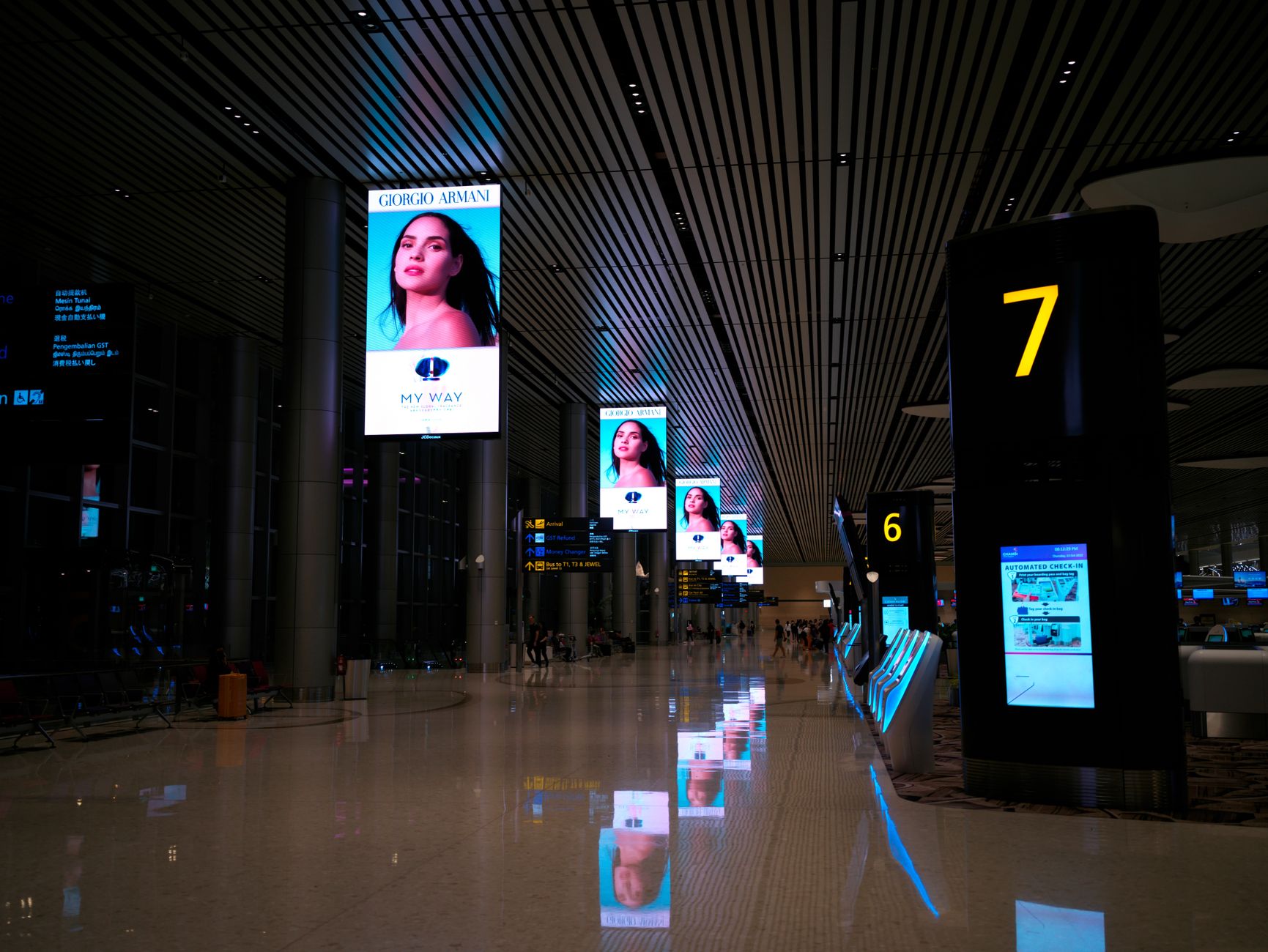
Hannover isn’t a hub airport with endless corridors — it’s a compact regional airport with three terminals that share a single continuous arrivals level. That sounds like a minor detail, but it makes the arrivals walk noticeably shorter than at Germany’s bigger airports: no Skytrain ride, no kilometre-long travelators, just short distances between gate, carousel and platform. If you know which terminal your flight uses and where the S-Bahn waits, you can often be on your way into the city within twenty minutes of touching down.
The airport sits in Langenhagen, roughly ten to eleven kilometres north-west of Hannover city centre — close enough that the airport has kept a regional-airport feel with short distances throughout, even as passenger numbers have grown noticeably in recent years.
Terminal A, B or C – Depending on Where You’re Flying From
Hannover Airport, in Langenhagen just north of the city right off the A352 motorway, splits its traffic across three connected terminals: A, B and C. Between them they offer 20 jet bridges — gates 1 to 6 in Terminal A, 7 to 12 in Terminal B, and 13 to 20 in Terminal C, by far the largest of the three buildings, opened in 1998. Terminals A and B, both dating from 1973, are the older of the three; Terminal A underwent a thorough refurbishment between April 2013 and July 2014 before reopening.
For arriving passengers, one distinction matters most: Terminals A and B mainly handle Schengen flights, while Terminal C is largely reserved for services outside the Schengen area, to the UK or Turkey, for instance. That’s what determines whether passport control awaits you after landing or not.
There’s also Terminal D, with gates 21 to 23, used for bus boarding only. It’s reactivated during peak periods (as of 2026) and for years was effectively reserved for the British Royal Air Force. Landing there simply signals an unusually busy schedule that day — the process itself barely differs.
Arrivals Level: One Floor for All Three Terminals
Hannover’s real advantage becomes clear the moment you step off the aircraft: the arrivals level sits at ground floor (E1) and runs continuously through all three terminals, while departures (E2) form an equally continuous floor one storey up. You don’t have to switch between entirely separate arrivals buildings the way you would at many larger airports.
Baggage claim sits within the arrivals area of whichever terminal handled your flight, with several carousels side by side and monitors showing which belt serves which flight. At an airport this compact, the gap between the aircraft parking up and the first case appearing is usually short — long waits of the kind you get at some major hubs are the exception here.
If you know the transfer system at Düsseldorf, you’ll appreciate the difference: there, arrivals and baggage claim sit considerably further apart depending on which concourse you land at, whereas Hannover’s short walks feel more like a well-organised regional airport.
Passport Control and Customs
Whether passport control awaits you after landing depends on where your flight originated, not on the terminal itself. Arriving from another Schengen country, the standard border check is waived — federal police carry out spot checks at most, and you head straight to baggage claim. Arriving from outside Schengen, typically via Terminal C, passport control comes before the carousel. Depending on how busy it is, allow ten to thirty minutes, more if several long-haul flights land close together.
After baggage claim, everyone passes through customs, with the familiar two exits: green for anything within your duty-free allowance or arriving from an EU country, red for goods that must be declared. That split works the same way at every German airport, Hannover included.
Passenger Numbers and Peak Times
Compared with Frankfurt or Munich, Hannover is a small airport, but it’s growing noticeably: 2025 saw around 5.34 million passengers, up from 5.22 million the year before — a rise of more than 13 percent on 2024. For comparison, the pandemic low in 2020 was only around 1.45 million. The airport recorded just over 65,800 flight movements in 2025.
For your arrival, that means queues at passport control and baggage claim stay more manageable than at Germany’s big hubs, even during the busiest windows — typically late morning and early evening, when several flights land close together. If a relaxed arrival matters more than the exact time, a weekday morning landing sees noticeably lighter traffic than weekends with several holiday charters landing at once.
Into the City on the S5 S-Bahn
The fastest way from the airport into town is the S-Bahn. The station, Hannover Flughafen, sits directly beneath Terminal C and is reachable from all three terminals via the continuous arrivals level plus escalators and lifts in a few minutes — it’s been running since May 2000, opened in time for Expo.
The S5 line connects the airport via Langenhagen to Hannover Hauptbahnhof, continuing on towards Weetzen, Hameln and Paderborn. Journey time to the main station is around 17 minutes, with trains running every half hour from the early morning until well past midnight (as of 2026). During major trade fairs, above all the Hannover Messe, an additional S8 service runs directly between the airport, the Hauptbahnhof and the Messe/Laatzen exhibition grounds.
Tickets come from the machines on the platform; the route falls within the GVH fare network. A single ticket covering the two fare zones between airport and Hauptbahnhof costs €4.70 (as of January 2026). If you already hold a Deutschlandticket (€63 a month, as of 2026), it covers this journey too, since it’s valid across the entire GVH network.
Compared with Hamburg’s S1 to the main station, which takes around 25 minutes, Hannover’s 17-minute run is actually the quicker of the two — a direct benefit of the airport’s compact layout.
Bus, Taxi and Rental Car from the Airport
Alongside the S-Bahn, ÜSTRA bus route 470 runs every 30 minutes between the airport and Langenhagen-Zentrum, useful if your destination doesn’t sit directly on the rail line.
Taxis wait at three ranks right in front of the terminals, with room for around 100 vehicles between them — enough capacity at busy times that you shouldn’t be left waiting long.
Rental cars are collected centrally between Terminal A and B: the connecting corridor on the arrivals level houses desks for six operators — Avis, Europcar, Hertz, Enterprise, Euromobil and Sixt — clustered close together. In practice that means: collect your bag, walk a short distance, pick up your hire car, all without leaving the terminal building.
Parking for Pick-Ups
If someone’s collecting you, the Kiss & Fly zones right outside every terminal are worth knowing about: stopping there is free for a few minutes, meant for a quick drop-off or pick-up rather than any real wait.
If you’re actually waiting out a delayed landing, the P1 to P3 car parks opposite the terminals are the better option — exiting within the first 30 minutes is normally free. After that, tiered short-stay rates apply based on how long you stay (as of 2026); for a wait of up to an hour the cost stays modest, and it rises by a small increment for each further quarter hour. In total, Hannover Airport offers around 14,000 parking spaces, including for longer stays.
Connecting Flights and Changing Terminals
Unlike Munich or Frankfurt, Hannover isn’t a major connecting hub — most passengers fly here to arrive, not to transfer onward. If you do have a connection, you’ll benefit from the short distances between the three terminals, but plan for this: if your connecting flight moves from a Schengen to a non-Schengen route or vice versa, you’ll typically go through checks again, even on a single through-ticket.
With a tight connection, it’s worth checking both flights’ terminal assignments at your departure airport rather than after landing — even though the distances involved in Hannover are considerably shorter than at the big hubs.
Accessibility and Travelling with Children
Accessibility is built into both levels at Hannover Airport: every terminal has wheelchair-symbol call points on both the arrivals and departures level, where you can request assistance directly, and the car parks include designated disabled spaces close to the lifts. If you need support arranged ahead of time, the airport service team can be reached in advance ([email protected]) — simplest is to register the request with your airline at booking stage, so help is organised at your destination before you land.
For families with young children, the short distances are an advantage in themselves: gate to carousel is rarely more than a few hundred metres, and luggage trolleys are free at the belts.
Lost or Damaged Baggage
If your case doesn’t appear on the belt, or arrives damaged, report it before you leave the building. The desk for the relevant airline or ground handler sits directly in the baggage claim area. There, a PIR (Property Irregularity Report) is filed — without one, any later claim becomes considerably harder. Keep your baggage tag to hand; it’s the direct proof of which case belonged to which flight.
Compensation claims are also subject to firm deadlines under the Montreal Convention: damage must be reported in writing within seven days of receiving your bags, and delay within 21 days of the bags being handed over. Miss those windows and you typically lose the claim, however clear-cut the case otherwise was.
It’s also worth photographing your case before check-in — a precise description helps more than you’d expect if things do go missing.
An airport on a very different scale, but with its own subway line running straight to the terminal, is Nuremberg, covered under Nuremberg Airport.
An airport with no station of its own, relying instead on a shuttle bus to the nearest regional station, is Dortmund, covered under Dortmund Airport arrivals.
All journey times, ticket prices and parking rates are as of 2026, based on information from Hannover Airport, Deutsche Bahn and the GVH. Fares and parking tariffs are typically revised annually, while terminal assignments and rail connections change less often — check the current rates directly with the GVH or the airport shortly before you travel. More on arrivals and baggage at German airports is under Arrival & Baggage.
Keep reading
Arrival & Baggage
Stuttgart Airport Arrivals: level 2, two halls and three ways into the city
Arriving at Stuttgart Airport in 2026: baggage reclaim and exits in Terminals 1 and 3 on level 2, customs and EES, pick-ups with 8 free minutes or an hour on P0, S2/S3, the U6 since 2021, the N8 night bus and taxis.
Sophie Bauer25 September 2026
Arrival & Baggage
Munich Airport Arrivals: Two Terminals, Two Levels
Arriving at Munich Airport in 2026: Terminal 1 on level 4, Terminal 2 on level 3, baggage claim centralised across 14 belts, the new Terminal 1 pier open since April 2026 — and the route through customs.
Sophie Bauer16 August 2026
Arrival & Baggage
Dortmund Airport Arrivals: One Terminal, Two Ways Into Town
Dortmund Airport arrivals in 2026: baggage claim, customs and choosing between the AirportExpress bus and a regional train via Holzwickede into town.
Sophie Bauer6 July 2026
Arrival & Baggage
Arriving at BER Airport: One Level, Two Exits, Two Terminals
Arriving at Berlin BER in 2026: baggage reclaim on level E0, eight belts in Terminal 1 and three in Terminal 2, the station two levels down, the FEX to Hauptbahnhof in 23 minutes — and the meeting point almost everyone gets wrong.
Sophie Bauer17 September 2026
Arrival & Baggage
Frankfurt Airport Arrivals: Terminal 1 or 3, Baggage, Customs and the Way Out
Arriving at Frankfurt Airport in 2026: where you land now Terminal 2 has closed, how passport control, baggage reclaim and customs work, and how to get onward from Terminal 1 and Terminal 3.
Sophie Bauer25 September 2026