Arriving at BER Airport: One Level, Two Exits, Two Terminals
BER puts the entire arrivals process on a single level. That sounds simpler than it turns out to be the first time: Terminal 1 has two arrivals exits, your suitcase may surface in Terminal 2, and the platform is not one floor down but two.

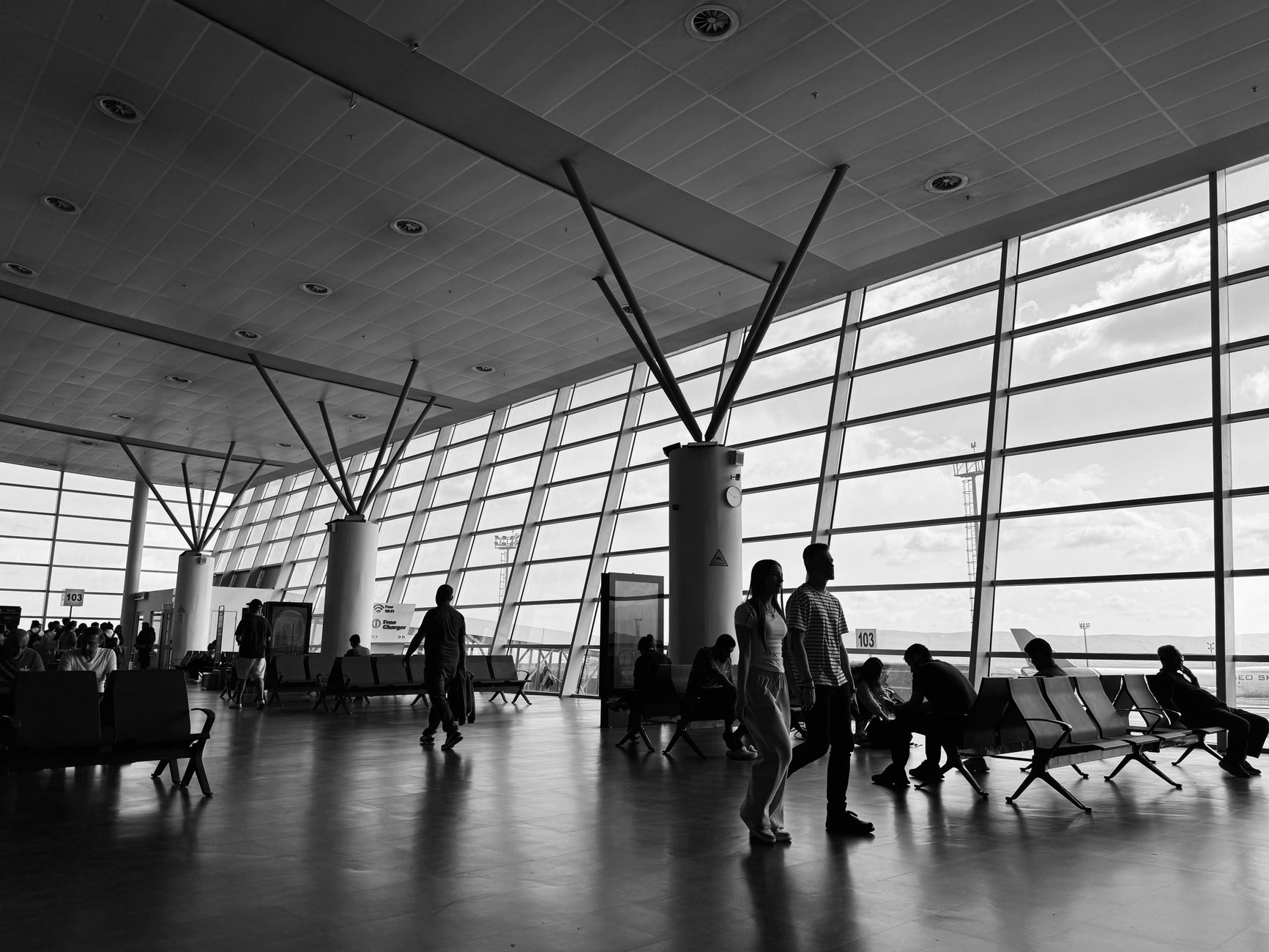
BER is the one major German airport where the whole of arrivals happens on a single floor: level E0. The arrival gates, baggage reclaim, the arrivals hall, the bus stops and the signposted walkway to Terminal 2 all sit at that same height. If you are used to Munich or Frankfurt, where you sort yourself out across three to five levels, the first visit feels like a relief.
People still manage to miss each other here — not because of the levels, but because of three things the floor plan does not advertise: Terminal 1 has two separate arrivals exits, your bags do not necessarily surface in the building you landed at, and the station is two levels below you, not one.
Which pier, which level: getting down from the gate
Terminal 1 is built in a U shape around three piers, and which one you get decides how long your walk to reclaim will be.
The main pier is the longest at roughly 715 metres and uses double-deck air bridges. The Schengen gates A01 to A20 and B01 to B20 sit on level E1; the non-Schengen gates C01 to C19 and D02 to D17 are a floor higher on level E2, along with the food court and the lounges. Land from Istanbul, London or New York and you enter the building at the top, working your way down through passport control and the signposted E2–E0 transfer routes. From Palma, Vienna or Zurich that walk starts a level lower.
The south pier has nine single-deck air bridges serving gates A30 to A38 — single-deck means no separate arrivals corridor, so you walk back along the same passage departing passengers are walking down. The north pier has no bridges at all: gates B30 to B45 are apron stands, used mainly by the low-cost carriers.
An apron stand has an underrated upside: the bus drops you at the bottom, on E0 or the intermediate level E0Z, so you skip the descent entirely. The cost is the wait while the bus fills — allow five to ten minutes more off the north pier than off an air bridge, and mention it to whoever is collecting you.
Baggage reclaim: eight belts in T1, three in T2
Baggage reclaim in Terminal 1 is a single central area on level E0 with eight belts in total. It sits before the exits from the security-controlled area — a sentence that matters again in a moment, when we get to being met.
Here is the part almost nobody expects: Terminal 2 has its own reclaim area, also on level E0, with three belts. T2 has no gates of its own — passengers who check in there walk across to board at Terminal 1’s B pier. On arrival the pattern reverses: you land at a gate in Terminal 1, but your suitcase can come out in Terminal 2 if your airline is handled there. The airport puts the walk between the two buildings at around five minutes, signposted across Terminal 1’s E0 arrivals level.
So don’t trust the terminal you landed at; trust the belt display with your flight number on it.
If a bag doesn’t turn up, the desk is still inside
The baggage tracing desk in Terminal 1 is, per the airport’s own listing, inside the controlled arrivals area, by reclaim outputs A1 to A4 on level E0. Terminal 2 has a desk of its own.
“Still inside” is the operative detail. Once you have walked through customs into the public arrivals hall, you cannot get back to the belt or to the desk — not without a detour via the information counter and a good deal more time. Report a missing or damaged bag before you walk out.
Your counterparty is the airline, not the airport. When you report it you are given a reference number for Worldtracer, the international baggage tracing system, which you use to follow the status and arrange onward delivery. Have the baggage receipt stuck to your boarding pass at check-in ready when you do.
Ankunft 1 or Ankunft 2: why “at the exit” doesn’t work
Now for the thing that genuinely goes wrong at BER on a regular basis. The official terminal plan shows two arrivals exits in Terminal 1 on level E0, signed Ankunft 1 and Ankunft 2, at widely separated ends of the U. Terminal 2 then has its own arrivals area alongside.
That makes two obvious arrangements useless. “Meet me at the carousel” is out, because people collecting you are not allowed in — reclaim sits before the exit from the controlled area. And “I’ll wait at the exit” is ambiguous, because Terminal 1 has two of them and Terminal 2 a third. The same applies to “at the taxi rank”: there are two in front of Terminal 1, north and south.
The workable fixed point is the airport information desk on level E0 in the public part of Terminal 1: staffed, signposted and unambiguous — there is exactly one in the freely accessible part of that level, the second being at the Marktplatz on E1 behind security, which is no use for a meeting.
Being collected by car: ten minutes are free
There are around 300 parking spaces directly in front of Terminal 1 for dropping off and picking up. The first ten minutes are free, capped at three uses per number plate within any eight-hour window. It runs on number-plate recognition, so there is no barrier to have a conversation at.
Ten minutes is enough to load someone already standing outside. It is not enough for a flight landing twenty minutes late, and nowhere near enough for passport control plus a wait at the belt. For anything beyond that a car park is the calmer answer; which areas at BER sit how far from the terminal and what they cost is broken down in this comparison of the BER car parks. The rule of thumb for anyone collecting: set off when your passenger is standing at the belt, not when the aircraft has touched down.
Two levels down: the station beneath Terminal 1
The airport station sits directly beneath Terminal 1 on level U2, with six platform tracks. Between the arrivals hall and the platforms, though, lies level U1 — the Airport City around Willy-Brandt-Platz, with shops, a bank, the Deutsche Bahn travel centre and lost property. So it is two floors, not one, and first-timers reliably hunt for a platform on U1 that isn’t there.
The services calling down there (as of 2026):
| Line | Destination | Journey time | Frequency |
|---|---|---|---|
| FEX | Berlin Hauptbahnhof | approx. 23 min | 24/7; every 15 min from 4am to 1am |
| FEX | Berlin Südkreuz | approx. 14 min | as above |
| RE20 | Berlin Hbf, onward towards Lübbenau | approx. 23 min to Hbf | hourly, approx. 4am–9pm |
| S9 | City centre out to Spandau | longer, many stops | every 20 min |
| S85 | Ostkreuz, Prenzlauer Berg, Frohnau or Pankow | longer, many stops | every 20 min |
| RB22 / RB24 / RB32 | Potsdam, Blankenfelde, Ludwigsfelde and others | depends on destination | hourly |
Until December 2026, an engineering timetable applies. While the Berlin Stadtbahn is closed to regional and long-distance trains (until 12 December 2026), the airport says FEX and RE20 together run only four times an hour, and cancellations and diversions are possible, particularly at night. The table above shows the regular timetable – check your connection before you land in the DB app or in BER’s travel notices.
One thing older guidebooks will still have you believing: the RE7 no longer serves BER — since the December 2025 timetable change its relief workings run all day only between Bad Belzig and Berlin-Wannsee. Regional travel from the airport now means RE20, RB22, RB24 or RB32. The S85, conversely, is new here, extended to the airport on 14 December 2025; together with the unchanged S9 that gives six S-Bahn departures an hour.
The ticket most people get wrong
BER is not in Berlin. It is in Schönefeld, in Brandenburg, and for fare purposes it sits in zone C. A journey into the centre therefore needs an ABC ticket; the AB one you may be used to is simply not valid on this route.
Since 1 January 2026 a Berlin ABC single costs €5.00 and the ABC 24-hour ticket €12.90 (as of 2026). From two journeys on your arrival day onwards, the day ticket is already the cheaper sum. The Deutschlandticket is valid on every line listed above, the FEX included, at no surcharge — the airport express here is not a premium product with its own supplement, unlike some airport expresses elsewhere. Buy tickets from the machines on U2 or in the app before you head down.
Taxis, ride apps and buses
Taxis: arriving passengers use the two ranks, north and south, in front of Terminal 1 on level E0. Departing passengers, by contrast, are set down a level higher on E1 — a detail that causes confusion on arrival too, when somebody tries to collect you from the departures forecourt. Terminal 2 has no forecourt at all; if you come out there, you follow the signposted walk over to Terminal 1.
On price: it is roughly 26 kilometres and about 37 minutes into the centre, with an indicative fare of €60 to €70 (as of 2026). A destination-by-destination breakdown of distance, drive time and fare is in this rundown of taxi runs from BER, and how fixed-price transfers, taxis and ride services compare in Berlin is worked through in this Berlin airport transfer price comparison.
Ride apps: Bolt, FREENOW and Uber have a dedicated area, the Ride App Pick up on the forecourt lane on arrivals level E0. That is not a formality — your booked car cannot stop at the taxi rank, and waiting there means watching your ride circle the airport in the app.
Buses: express buses X7 and X71 leave from bus stops A2 and A6–A7 respectively on arrivals level E0 — worth knowing if your destination is in southern Berlin and you would rather not detour through the centre.
A realistic timetable
From landing to Hauptbahnhof, on a Schengen flight with checked baggage:
- Disembarking and walking down to E0: 5–15 minutes, depending on the pier
- Waiting at the belt: 10–20 minutes
- Walk to the platform on U2 including a ticket: 5–10 minutes
- FEX to Hauptbahnhof: 23 minutes
That comes to 45 to 70 minutes. Hand-luggage only, with a well-timed FEX, you are looking at around 35. Arriving from outside Schengen, add passport control — ten to thirty minutes more depending on the queue.
How the same walk looks at an airport with one central reclaim shared between two terminals is covered under Hamburg Airport arrivals. And how the same question plays out in a differently shaped city is set out in this side-by-side of the options from Frankfurt Airport into the centre, where S-Bahn, long-distance rail and taxi compete over a far shorter distance than in Berlin.
For the return journey, from Terminal 1 or 2 to evening check-in and security, there is a separate guide: BER Airport departures. If you land late and the last FEX is looking tight, a night at the airport is the less stressful option: hotels at BER Airport. The wider picture of terminals, history and getting there is under Berlin Brandenburg Airport, and the prehistory of Berlin’s air traffic under Berlin-Tempelhof Airport.
All routes, levels and belt counts are as of 2026, per Flughafen Berlin Brandenburg GmbH; timetables and VBB fares are revised annually. If you remember only two things: buy an ABC ticket, and agree a meeting point that has a name rather than being “the exit”. More arrival routes at German airports are under Arrival & Baggage.
Keep reading
Arrival & Baggage
Frankfurt Airport Arrivals: Terminal 1 or 3, Baggage, Customs and the Way Out
Arriving at Frankfurt Airport in 2026: where you land now Terminal 2 has closed, how passport control, baggage reclaim and customs work, and how to get onward from Terminal 1 and Terminal 3.
Sophie Bauer25 September 2026
Arrival & Baggage
Stuttgart Airport Arrivals: level 2, two halls and three ways into the city
Arriving at Stuttgart Airport in 2026: baggage reclaim and exits in Terminals 1 and 3 on level 2, customs and EES, pick-ups with 8 free minutes or an hour on P0, S2/S3, the U6 since 2021, the N8 night bus and taxis.
Sophie Bauer25 September 2026
Arrival & Baggage
Munich Airport Arrivals: Two Terminals, Two Levels
Arriving at Munich Airport in 2026: Terminal 1 on level 4, Terminal 2 on level 3, baggage claim centralised across 14 belts, the new Terminal 1 pier open since April 2026 — and the route through customs.
Sophie Bauer16 August 2026
Arrival & Baggage
Düsseldorf Airport Arrivals: Two Stations, Three Terminals
Arriving at Düsseldorf Airport: which terminal serves which airline, how long baggage takes, and why there are two different railway stations.
Sophie Bauer14 August 2026
Arrival & Baggage
Arriving at Hamburg Airport: From Gate to City Centre in 40 Minutes
Arriving at Hamburg Airport: central baggage reclaim, the S1 to the main station in 25 minutes, taxi fares — and the train split that catches people out.
Sophie Bauer14 August 2026