Arriving at Hamburg Airport: From Gate to City Centre in 40 Minutes
Hamburg is one of Germany's most straightforward airports to arrive at: baggage reclaim sits centrally between both terminals, and the S-Bahn leaves from almost directly beneath you. Two things are still worth knowing first.

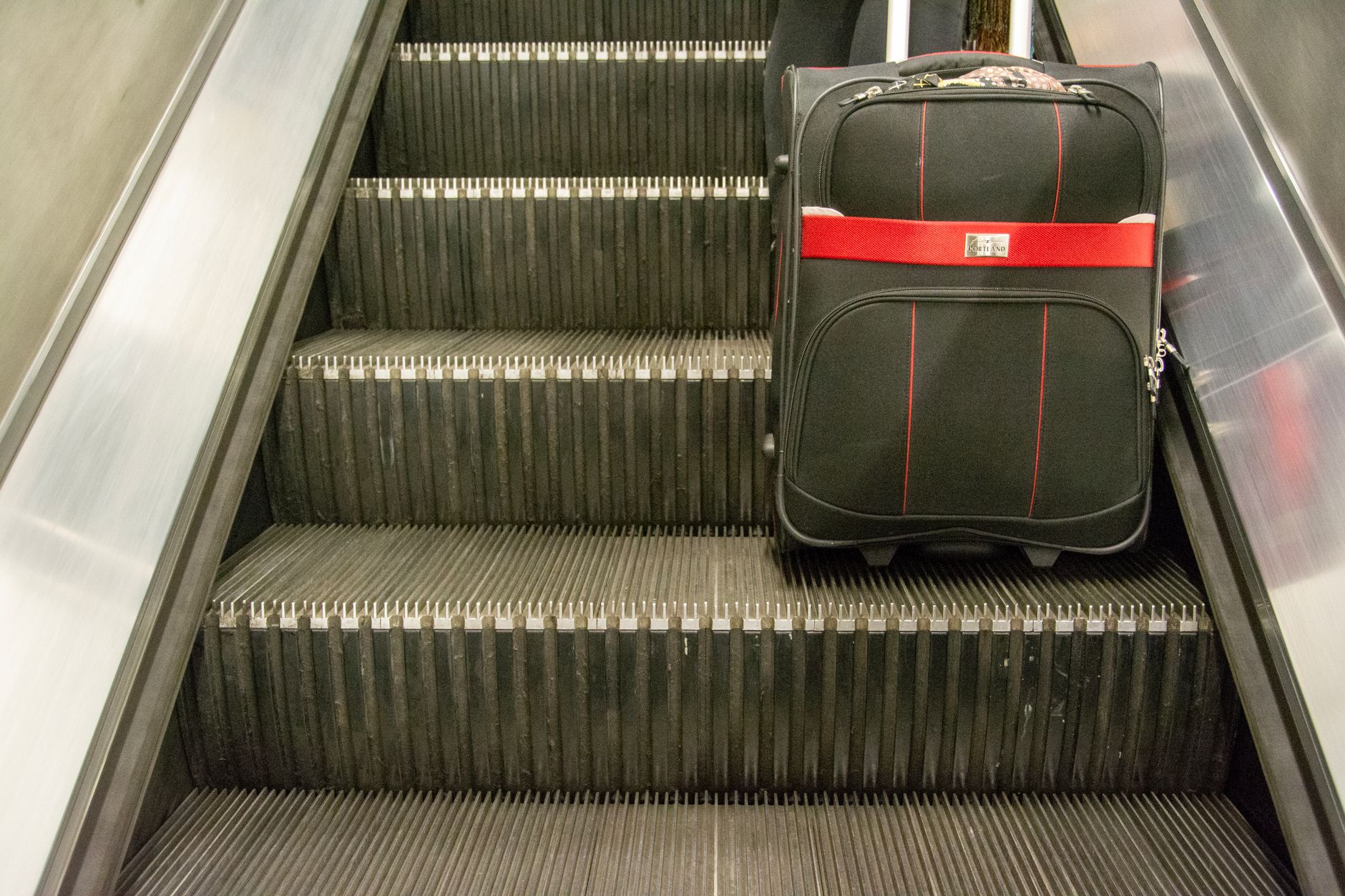
Hamburg Airport is small enough that you can’t get lost in it and well enough connected that you don’t need a taxi. If you’re landing here for the first time: from touchdown to the main station takes a realistic forty to fifty minutes, waiting for luggage included. Few other major German airports manage that.
Two things are still worth knowing in advance. One concerns baggage reclaim, the other the S-Bahn on your way back — and the second regularly costs people their flight.
Two terminals, one baggage reclaim
Hamburg has Terminal 1 and Terminal 2, and both hang off the same middle: the Airport Plaza. That’s the connecting building between the terminals, housing both security and the central baggage reclaim.
For an arriving passenger that means something rather pleasant: it doesn’t matter which terminal you land at. You don’t walk into a terminal-specific arrivals building — you take escalators and lifts down to the shared reclaim area. There are plenty of trolleys there, and two cash machines, which is handy if you’ve arrived without euros.
If you’re wondering which terminal your airline uses: published accounts disagree, and the allocation shifts over the years. Trust your boarding pass and the boards on the day rather than a list online. For arrivals it’s largely academic anyway — the route goes through the Plaza either way.
Getting to the S-Bahn
The station is called Hamburg Airport (Flughafen) and sits directly at the building. You reach it from the arrivals level of both terminals by lift, escalator or stairs.
This is where Hamburg genuinely scores. Between the baggage carousel and the platform there’s a few minutes’ walk — no shuttle bus, no terminal change, no detour through a car park.
Into the city on the S1
The S1 connects the airport with the centre:
| Journey time to Hauptbahnhof | 24–25 minutes |
| Frequency (approx. 6am–11pm) | every 10 minutes |
| Frequency outside those hours | every 20 minutes |
| Single to Hauptbahnhof | €4.10 (as of 2026; 7% less in the app) |
Tickets come from the machines on the platform, the DB travel centre in Terminal 2, or the HVV service point in the arrivals hall. If you’re making several journeys in Hamburg, weigh a day ticket against singles — from three journeys it almost always wins.
One note for anyone already on a season ticket: the Deutschland-Ticket is valid across the whole HVV network, this route included. If you have one, the airport transfer costs you nothing extra.
The train split at Ohlsdorf — the real trap
Here’s the thing to remember, even though it doesn’t affect you on arrival.
The S1 divides at Ohlsdorf. The front three carriages run to the airport; the rear three continue to Poppenbüttel. So if you’re travelling out from the city and sitting in the rear portion, you’ll end up in Poppenbüttel and have to come back to Ohlsdorf and start again. Depending on the frequency that costs you twenty to thirty minutes.
It’s announced on the platform and on board, but it reliably gets lost in a crowd. The rule is simple: travelling to the airport, always take the front section.
Arriving, the reverse causes no problem — the train leaves the airport whole and is joined to the Poppenbüttel portion at Ohlsdorf. Sit wherever you like.
Taxis and buses
A taxi into the centre costs roughly €25 to €35 depending on destination and traffic, and takes 20 to 30 minutes. With two people that’s already worth considering; with three or four and luggage it’s almost always more sensible than four single fares.
But in fairness, the time saving is slight. The S1 takes 25 minutes and the taxi 20 to 30 — and in rush hour the taxi can be slower, because the S-Bahn doesn’t sit in traffic. In Hamburg you’re buying comfort with luggage, not speed.
How taxi fares are constructed in general is a subject of its own; for this transfer what matters is that the journey is short, so the base fare weighs more heavily than the distance.
Arriving from outside Schengen
Coming from outside the Schengen area — the UK, Turkey, the United States — passport control comes before baggage reclaim. Allow ten to thirty minutes extra depending on the queue.
Two things speed it up noticeably. Have your passport out, not in a bag inside your hand luggage. And use the automated gates if you’re eligible — for EU citizens with a biometric passport that is considerably quicker than the desk.
For planning purposes: landing from London, budget nearer seventy minutes than fifty for the whole journey to the main station. Arriving from within Germany or the Schengen area, you go straight through to reclaim.
Meeting people, and being met
If someone’s collecting you, there are two approaches.
Pulling up briefly works at the forecourts, but as everywhere it’s meant for setting down and picking up, not waiting. Anyone waiting blocks the lane — and with a delayed flight, waiting twenty minutes happens quickly.
Parking near the terminals is the calmer option: the airport has readily accessible spaces right by the buildings. For a flight running late, that’s the solution that doesn’t produce a conversation with airport security.
The practical tip for both sides: arrange to meet in the arrivals hall, not at the carousel. Baggage reclaim is a controlled area for arriving passengers; people meeting you can’t get in. And pick a specific point rather than “the exit” — the Plaza has several.
If you land late
After 11pm the picture changes. The S1 then runs only every 20 minutes rather than every ten — and with a delayed landing plus a wait at the carousel, that can be the difference between a relaxed half hour and a very long one.
Two things help. First, check the next departure while you’re still on the aircraft, not once you’re on the platform. Second, arriving close to the end of service, a taxi isn’t a luxury — it’s the connection that still exists.
Car hire desks are likewise at the terminal, and car-sharing operates at the airport too. Book either in advance for a late arrival, though: the desks aren’t staffed around the clock.
If your luggage doesn’t arrive
It’s rare, but there’s a clear procedure, and the most important part of it is about timing.
Report it before you leave the baggage area. At the baggage service desk a lost property report is raised — the PIR. Without that report, any later claim becomes complicated, and anyone who first rings up from home has already given away their strongest card.
Take the baggage receipt stuck to your boarding pass at check-in. Without it everything takes longer. And photograph your case before you check it in — it helps with the description more than you’d expect.
What you should know generally about lost baggage, delays and compensation is under Arrival & Baggage.
The realistic timetable
For arriving in Hamburg, from landing to the main station:
- Disembarking and walking to reclaim: 5–10 minutes
- Waiting for luggage: 10–20 minutes (nil if you have none)
- Walk to the S-Bahn and buying a ticket: 5–10 minutes
- Journey to Hauptbahnhof: 25 minutes
That’s 45 to 65 minutes with a suitcase and 35 to 40 without. Travelling hand-luggage-only, you’ll be in the city considerably faster than at Frankfurt or Munich — which is this airport’s real advantage.
What to allow before departure on the way back is under Departure & Security; the hand luggage rules are in the size comparison and the piece on liquids. Which terminal your airline uses for the flight home, and how Slot & Fly gets you through the central checkpoint in the Plaza, is covered in Hamburg Airport departures.
How the arrivals route looks at an airport laid out differently is under Düsseldorf Airport arrivals.
An airport with an even simpler arrivals layout, sharing one level across three terminals, is Hannover, covered under Hannover Airport arrivals.
All details are as of 2026. Local transport fares are revised annually, while routes and frequencies change rarely. If you remember only one thing: front three carriages. That’s the difference between a relaxed departure and a sprint through Ohlsdorf.
Keep reading
Arrival & Baggage
Stuttgart Airport Arrivals: level 2, two halls and three ways into the city
Arriving at Stuttgart Airport in 2026: baggage reclaim and exits in Terminals 1 and 3 on level 2, customs and EES, pick-ups with 8 free minutes or an hour on P0, S2/S3, the U6 since 2021, the N8 night bus and taxis.
Sophie Bauer25 September 2026
Arrival & Baggage
Arriving at BER Airport: One Level, Two Exits, Two Terminals
Arriving at Berlin BER in 2026: baggage reclaim on level E0, eight belts in Terminal 1 and three in Terminal 2, the station two levels down, the FEX to Hauptbahnhof in 23 minutes — and the meeting point almost everyone gets wrong.
Sophie Bauer17 September 2026
Arrival & Baggage
Frankfurt Airport Arrivals: Terminal 1 or 3, Baggage, Customs and the Way Out
Arriving at Frankfurt Airport in 2026: where you land now Terminal 2 has closed, how passport control, baggage reclaim and customs work, and how to get onward from Terminal 1 and Terminal 3.
Sophie Bauer25 September 2026
Arrival & Baggage
Düsseldorf Airport Arrivals: Two Stations, Three Terminals
Arriving at Düsseldorf Airport: which terminal serves which airline, how long baggage takes, and why there are two different railway stations.
Sophie Bauer14 August 2026
Arrival & Baggage
Arriving at Hannover Airport: Three Terminals, One Arrivals Level
Arriving at Hannover Airport in 2026: Terminals A, B and C share one arrivals level, plus baggage claim, customs and the S5 to Hauptbahnhof in around 17 minutes.
Sophie Bauer19 August 2026