Flying With a Dog or Cat: Eight Kilos, the Microchip and the Cabin-or-Hold Question
Eight kilograms including the carrier: that single number decides whether your dog sits in the footwell in front of you or travels below in the hold. Behind it sit a fixed order of microchip and rabies jab, a 21-day wait — and a breed list that exists for a sad reason.

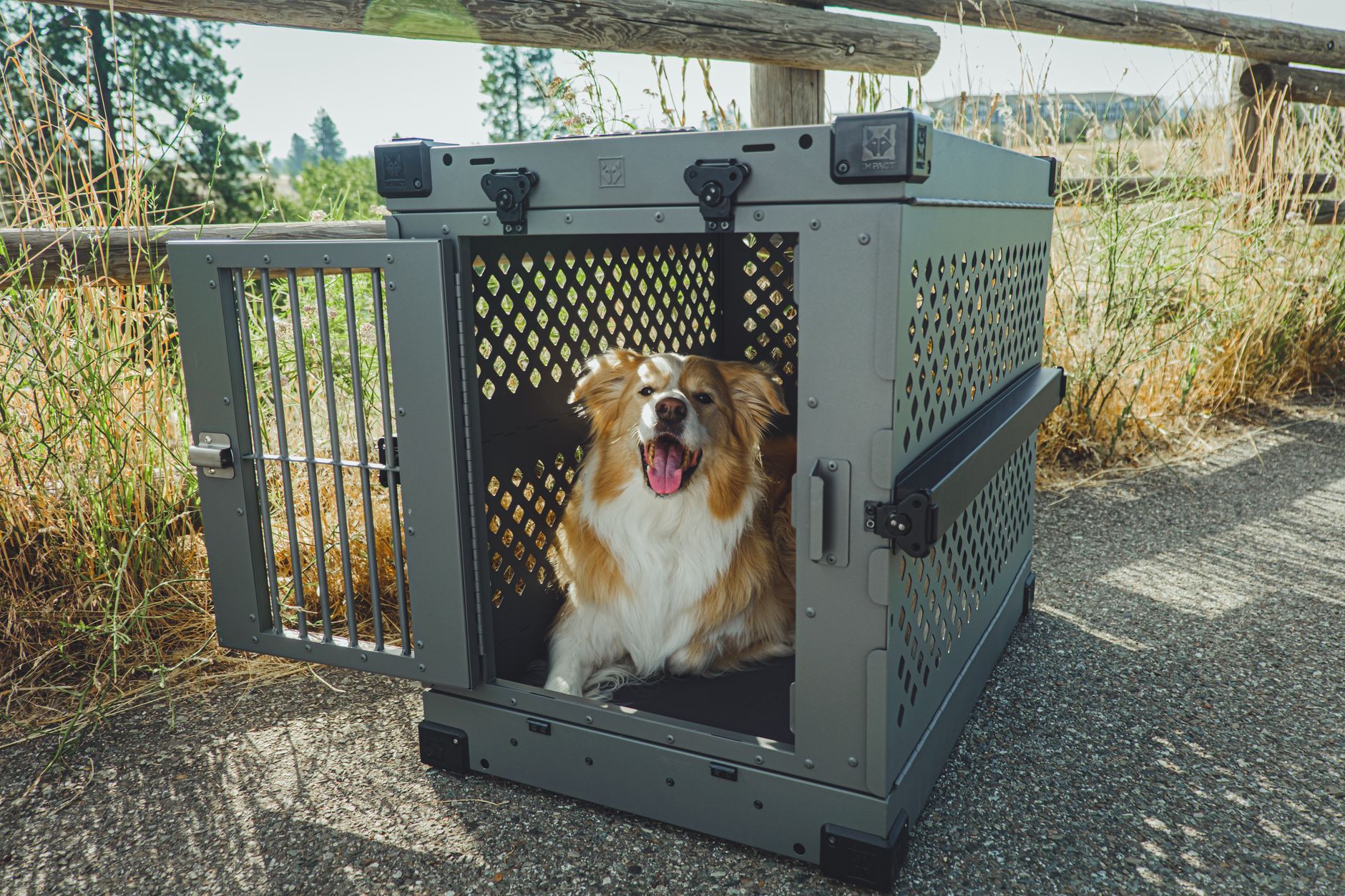
There is one number on which almost everything hangs at most European airlines: eight kilograms, animal plus carrier. Under it, your dog comes into the cabin, into the footwell in front of your seat. Over it, he travels in the hold — or, depending on the airline, not at all. Vaccinations, paperwork, breed lists, handover desks: everything else follows from that first fork in the road.
Unlike suitcase dimensions, this is not purely a rules question: a flight means noise, pressure changes and hours without movement. Which is why the question that belongs at the front sits at the end of this piece: does the animal need to come at all?
Dogs as hand luggage: what each airline actually allows
The eight kilos are convention, not law, and the detail underneath varies sharply. Some airline pages refused automated requests while I was writing this, so I have said where each figure comes from.
Eurowings (own website, September 2026) is the clearest case: cabin only, small dogs and cats up to 8 kg including the bag, no hold transport whatsoever. The bag must be leak-proof, bite-proof, closed but air-permeable, explicitly not a hard-shell carrier, and no larger than 55 × 40 × 23 cm. Exit-row and first-row seats are blocked, and there are route exclusions: no animals at all to or from the UK and Ireland, no cabin animals to or from Dubai, Marsa Alam or Keflavík.
Lufthansa: the animal pages on lufthansa.com answered every request with a 403, so I could not confirm the current fare and deliberately quote none. Reachable was Lufthansa’s own cabin acceptance form, dated April 2023, which sets the frame: dog or cat maximum 8 kg including the transport bag, soft-sided carrier max. 118 cm total (55 × 40 × 23 cm), adequately ventilated even when closed, leak- and escape-proof. Minimum age 12 weeks, and 15 weeks to or from Germany. Plus one line I come back to: snub-nosed breeds are excluded from the hold.
Condor, Ryanair and easyJet I could not check — two of those servers reject automated requests outright, and Ryanair’s help pages load only in a browser. Figures circulating for these three are second-hand. Take the number from your own booking flow, not from a guide — including this one.
That the maximum carrier dimensions match the large cabin bag exactly is no coincidence: it is the same footwell limit. Which suitcase clears which airline is set out under hand luggage sizes compared — and the animal’s bag usually does not replace your cabin bag, it sits on top of it and costs extra.
Cats in the cabin: same number, different animal
Cats get the same eight kilos and the same dimensions, so almost every adult domestic cat fits in the cabin while for dogs even a medium-sized terrier already fails. The cat is the easier traveller by the rules and the harder one by temperament. The soft bag is a cage to her unless she has known it for weeks — leave it open in the flat well ahead rather than buying it on the day. And a cat will find any opening: the escape-proof requirement is why staff inspect the zips. Taking her out or onto your lap is not permitted at any point.
The point at which the animal goes below
Above eight kilograms including the box there is no way around the hold — except for recognised assistance animals, which fly in the cabin regardless of weight; Munich Airport draws the line in precisely that place. Below deck the airline’s bag dimensions stop applying and the standard of the industry body IATA takes over, worked through at check-in with an acceptance checklist. As Munich describes it, the dog must be able to stand, turn and lie down in the box, which must be ventilated on four sides, escape-proof, fitted with two fixed bowls accessible from outside and lined with absorbent material. This is where most people come unstuck: the box from the DIY store is one size too small, or has no bowl mounts. In the hold the animal is usually billed as an extra or overweight bag rather than a ticket — how that is priced is under excess and checked baggage fees.
Snub noses: why pugs, bulldogs and Persians are excluded
The exclusions for snub-nosed — clinically, brachycephalic — breeds are not bureaucracy. They are in the conditions of carriage because animals have died. The German kennel club VDH, in its June 2020 position paper, names Brachycephalic Obstructive Airway Syndrome (BOAS), a term covering, in its words, a whole complex of serious upper-airway problems. Shortened noses mean narrowed airways, and dogs cool themselves almost entirely by breathing; heat and stress hit the function already running at its limit — and a cargo hold is both. The American Veterinary Medical Association records that airlines identified brachycephaly as a risk factor from examination and necropsy findings, and that breeds such as bulldogs and pugs made up around half of the dogs that died in cargo with US airlines.
There is no single list, and that is the practical trap. The VDH points to the twelve breeds regulated in the Netherlands: affenpinscher, Belgian griffon, Boston terrier, Brabant griffon, Brussels griffon, bulldog, French bulldog, Japanese chin, King Charles spaniel, pug, Pekingese and shih tzu. Airlines keep their own lists, which differ and can include cat breeds — so get your breed confirmed in writing when you register the animal. If your pet is small enough for the cabin the question largely dissolves: the exclusion normally applies to the hold, not the footwell.
Microchip, rabies jab, pet passport — the order is what counts
Within the EU this is governed by Regulation (EU) No 576/2013 on the non-commercial movement of pet animals. Article 6 sets four conditions for dogs, cats and ferrets: they must be marked; they must have an anti-rabies vaccination complying with the validity requirements of Annex III; they must comply with any preventive health measures for other diseases; and they must be accompanied by a properly completed identification document — the EU pet passport.
The decisive line sits in Annex III and is routinely missed: the date of vaccination must not precede the date on which the transponder or tattoo was applied. Chip first, then the jab — reverse the order and the animal has to be vaccinated again, because the chip cannot be backdated. Annex III also requires the animal to have been at least 12 weeks old when vaccinated, and sets protective immunity to begin no earlier than 21 days after completion of the primary vaccination protocol. A booster counts as a fresh primary vaccination if given after the previous one expired: a lapsed course costs the full 21 days again.
Bavaria’s border inspection post at Munich Airport puts this concretely for entry into Germany: a 15-digit ISO microchip implanted before the recognised rabies vaccination; vaccination at 12 weeks, that is 84 days, at the earliest; then a 21-day wait. Arithmetically that is 15 weeks, exactly the figure Lufthansa and Eurowings quote for flights to and from Germany. The border post itself, however, writes that dogs, cats and ferrets may enter Germany no earlier than 16 weeks of age. Planning tight, take the authority’s 16 weeks — it is the authority that checks, not the airline.
Article 5 additionally caps a single non-commercial movement at five animals; more are permitted only for competitions, exhibitions or sporting events, with written evidence of registration and for animals over six months. Anything beyond that is commercial import. Non-EU countries add further requirements, often a rabies antibody test with months of lead time.
What it costs (as of 2026)
One figure I can give reliably: Eurowings quotes carriage of an animal up to 8 kg on its own site at from €60; Lufthansa’s and Condor’s current prices were not retrievable. Check whether the price applies per journey or per flight segment — on a connecting itinerary that is the difference between paying once and twice. Then come the items nobody budgets for: the IATA-compliant box, the vet appointment, and for non-EU destinations the health certificate.
Where animals are handed over at Frankfurt and Munich
At Frankfurt the paths part at the terminal. In the cabin, you go to the ordinary check-in desk for your flight. As excess baggage, the airport names the airline’s bulky baggage counter, about two hours before departure, and returns the animal in the arrivals terminal where bulky luggage is released. Only animals travelling alone as cargo, or with a stopover longer than three hours, are handled at the Animal Lounge, Lufthansa Cargo’s animal station, through which its operator says some 15,000 dogs and cats pass each year. Arriving from outside the EU you report to the red customs channel, where papers and microchip are checked. And one restriction that catches transfer passengers: there are no designated pet relief areas in Frankfurt’s transit zones. A look at the layout of all terminals and the routes between them is worth it before you set off with a box and a lead; timings are under departures at Frankfurt, and if checked baggage goes wrong, that same area is the address — deadlines under delayed and lost baggage.
At Munich the airport asks passengers with an animal to be at the check-in desk two to three hours before departure. Animals over eight kilos are handed in afterwards at a bulky baggage counter; on arrival staff return the animal at the carousel or bulky baggage point, while animals sent as cargo are collected at the cargo centre, or at the border inspection post if you arrive from outside the EU. The veterinary border inspection post with small-animal station sits on level 00 before security, Südallee 17, open Monday to Friday 08:00 to 16:30. Transferring is easier here: checked animals are, by the airport’s own account, automatically cared for and put onto the connecting flight. And there are real relief areas — in front of the terminals, plus airside in Terminal 1, hall C1 West, and in the Terminal 1 pier on levels 03 and 04. Dogs must be on the lead throughout.
One thought for the drive out: an IATA box plus dog plus suitcase does not fit in every taxi, and a driver may refuse an animal. With a transfer booked in advance you can specify the vehicle and the pet rather than negotiating at the rank.
When driving is the more honest decision
Within Germany and to neighbouring countries the car is simply better for many dogs: no hold, no separation, breaks when they are needed. How far apart Berlin and Munich really are by road and how long the drive takes is quickly checked — and against that the flight costs not only the fare plus the animal fee but the car standing idle for the whole trip: what longer-stay parking at Frankfurt Airport costs is a noticeable line item over a week. Once the drive is under about eight hours, the car wins with a large dog almost every time — and with a snub-nosed one regardless.
If you do have to fly, the preparation is mundane and effective: chip before jab, 21 days of buffer, the box turned into familiar furniture weeks ahead, the long walk immediately before you leave, the desk time set generously. Sedatives are not a default but a decision made with your vet beforehand. And if you want three numbers: eight kilos, 21 days, five animals. Everything else is in your booking confirmation.
Keep reading

Departure & Security
Sports Equipment on a Plane 2026: Skis, Bikes, Golf Bags and Surfboards — Fees and Rules at Five Airlines
Flying with sports equipment in 2026: what skis, bikes, golf bags and surfboards cost at five airlines, the size and weight limits, how a bike must be boxed, and where the oversize desks are at Frankfurt and Munich.
Sophie Bauer25 September 2026
Departure & Security
British Airways Hand Luggage 2026: Two Bags Included, Even on the Cheapest Fare
British Airways hand luggage 2026: cabin bag and personal item dimensions, why even the Basic fare keeps both pieces, and what applies flying from Frankfurt, Munich and Düsseldorf. As of 2026.
Sophie Bauer27 July 2026
Departure & Security
EasyPASS in Germany 2026: Who Can Use the Border eGates and How They Work
EasyPASS in 2026: EU passport holders from age 12, eight airports with 255 eGates, EasyPASS-RTP for US, UK, Korean, Taiwanese and Hong Kong travellers — and where the EES fits in.
Sophie Bauer25 September 2026
Departure & Security
Eurowings Hand Luggage 2026: BASIC, SMART and BIZclass Compared
Eurowings hand luggage 2026: dimensions for the small bag and the cabin case, what BASIC, SMART and BIZclass actually include, plus a comparison with Lufthansa and Ryanair. As of 2026.
Sophie Bauer14 August 2026
Departure & Security
Food in Hand Luggage: What Gets Through Security — and What You Cannot Bring Home
Food in hand luggage 2026: why yoghurt, soft cheese and honey count as liquids at security, how the baby-food exemption actually works, and which foods the EU bans on the way back in.
Sophie Bauer17 September 2026